
The cost of compliance to the average sole practitioner practice has increased by more than 1086% in the last decade. That’s according to a recent investigation by the National Association of Specialist Dental Accountants and Lawyers (NASDAL). This sees an even greater increase than in 2014 when NASDAL last ran such an investigation (and a figure of 845%).
The investigation found that the advent of the Care Quality Commission (CQC), HTM01- 05 and a ‘culture of compliance’ had increased dentists’ costs massively.
Back in the mid-2000s, the essential requirements for setting up in practice were a one-off registration fee to the General Dental Council and an annual retention fee and registration with the Information Commissioner’s Office. The scene is now very different.
In 2016 it has been estimated that it costs a single handed practitioner £15,150 on an annual basis to meet the requirements of CQC and compliance alone. Combined with the various mandatory registration fees and indemnity, the figure reaches £21,875, an overall percentage increase in the cost of compliance of 1086%, compared to general inflation over the same period of 35%.
Nick Ledingham, Chairman of NASDAL and a partner in specialist dental accountants Morris and Co, said, “While there has had to be a certain amount of conjecture in calculating staffing costs and training in an average practice, we have strived to be conservative throughout this investigation. We hope that by demonstrating the burden of costs faced by practice-owners that sensible policy decisions will be made.”
The estimated annual costs of meeting the costs of compliance includes the time the team spends on decontamination and maintaining records, data protection and financial compliance as well as any time spent upon administration and staff training.
When asked to comment on the figures, Simon Thackeray, full-time practitioner and occasional CQC Special Advisor said, “It now seems that almost every meeting that I have will involve some element of compliance. It can be difficult to carry out a complete time and motion study but I think it is not unreasonable to suggest that one full day of a full-time member of staff’s week will be spent dealing with compliance related issues.
“The cost of indemnity has more than doubled in a three year period. These seem to be spiralling out of control as our society becomes more litigious and we are able to offer more and more advanced treatments.”
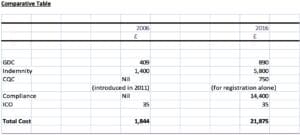
Compliance costs for a sole practitioner in 2006 and then in 2016
Alan Suggett, media officer of NASDAL and a partner in UNW LLP, added, “No-one is questioning the need for adequate safeguards and professional practice. However, it seems that in the last 10 years or so, a ‘culture of compliance’ has sprung up which seems to see compliance as an end in itself.”
ENDS
Note to editors:
NASDAL, the National Association of Specialist Dental Accountants and Lawyers, was set up in 1998. It is an association of accountants and lawyers who specialise in acting for and looking after the accounting, tax and legal affairs of dentists. It is the pre-eminent centre of excellence for accounting, tax and legal matters concerning dentists. Its members are required to pass strict admission criteria, and it regulates the performance of its members to ensure high standards of technical knowledge and service.
Images are available of the NASDAL Chairman and NASDAL team.
Nick Ledingham, the Chairman of NASDAL, is available for interview. To organise to speak to him or any other members of NASDAL for more information please contact Chris Baker on 07947 470896.
To view the article please download the PDF